


- About WXPress
- WXPress is your window into the world of WuXi AppTec and our global partners.
- Sitemap
- Events
- Contact
- Please reach out with any business inquires.
- communications@wuxiapptec.com
© 2026 WuXi AppTec. All Rights Reserved.Privacy Policy
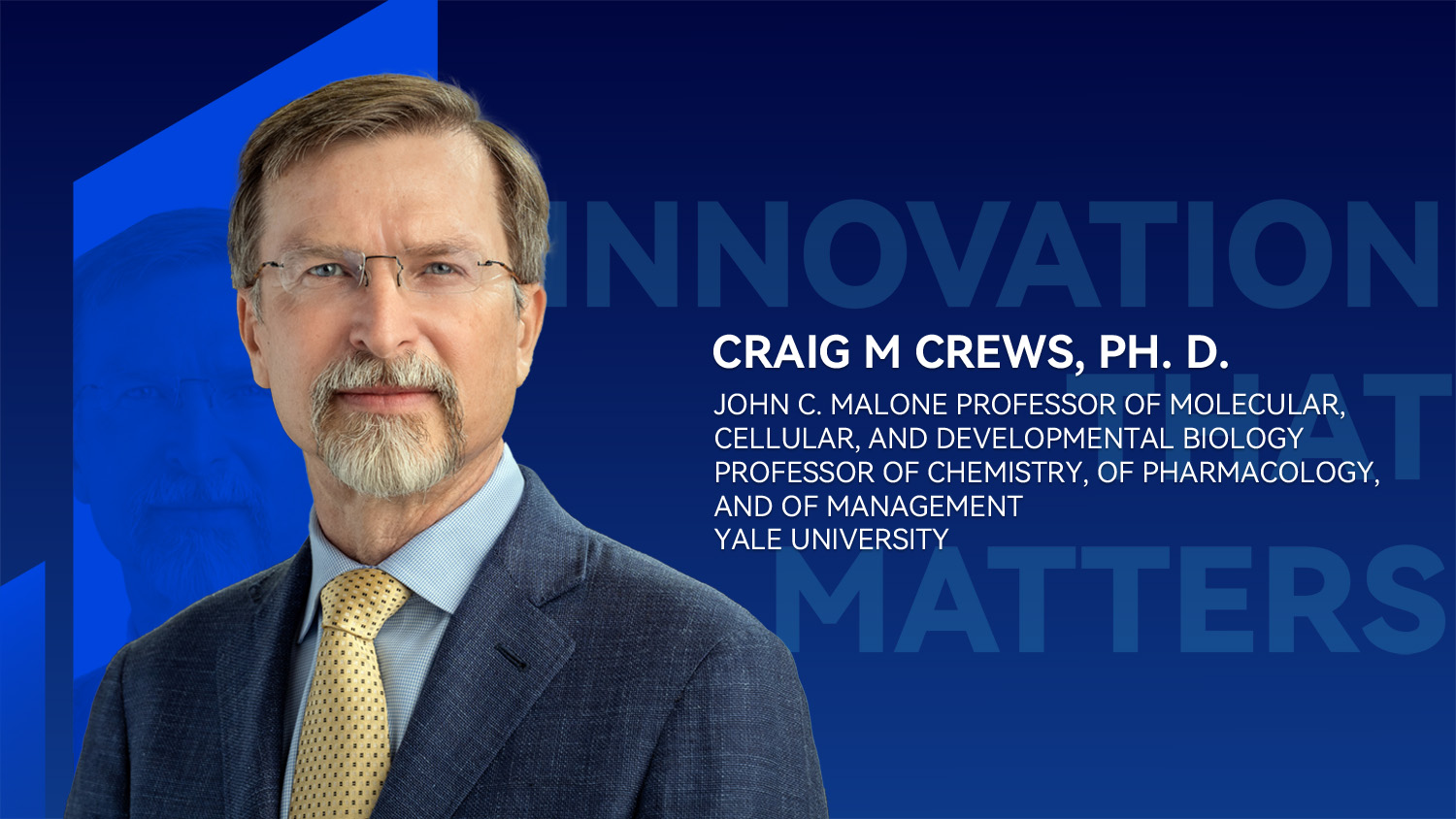
In May 2026, the FDA approved the first PROTAC therapy, marking the arrival of an entirely new class of medicines built on a once-radical idea: instead of merely inhibiting disease-causing proteins, drugs could be designed to eliminate them altogether. At the center of that story is Prof. Craig Crews, whose laboratory at Yale University helped pioneer the PROTAC (PROteolysis TArgeting Chimera) approach more than two decades ago.
Over the course of his career, Prof. Crews has bridged academia and biotechnology in unusual ways. In 2003, he co-founded Proteolix, whose proteasome inhibitor Kyprolis later received FDA approval for multiple myeloma. He subsequently co-founded Arvinas, the company that helped advance PROTAC therapeutics into the clinic and ultimately led to this year’s approval. His third company, Halda Therapeutics, which was recently acquired by Johnson & Johnson, focuses on developing a new induced-proximity-based modality called RIPTAC (Regulated Induced Proximity Targeting Chimeras).
Following the historic approval of the first PROTAC therapy, we spoke with Prof. Crews about the origins of the idea, the skepticism that initially surrounded the field, the scientific turning points that transformed targeted protein degradation into a viable drug modality, and why he believes induced proximity technologies may fundamentally reshape the future of medicine.
Craig Crews: To me, the approval represents something much larger than a single drug or even a single modality. I still remember the excitement surrounding the Human Genome Project in the 1990s. It felt transformative from a drug-discovery perspective. Suddenly we could see the enormous landscape of potential disease-related proteins across biology.
But over the years, it also became clear how limited our therapeutic reach actually was. Most of our drugs could only target proteins that were controllable through traditional small-molecule inhibition. That’s why we came up with PROTAC and induced proximity. It gives us a way to think beyond classical inhibition and begin using the cell’s own machinery to manipulate proteins in entirely new ways.
I hope it encourages scientists to think more creatively about how we control biology, how we manipulate proteins, interactions, and cellular systems to address disease. Because once you realize proximity itself can become a therapeutic principle, the boundaries of what may be druggable start to expand dramatically.
Craig Crews: The story really goes back to my early years as an assistant professor at Yale. At the time, I had received a junior faculty award to explore this heterobifunctional concept, the idea that you could use a molecule to bring two proteins together inside a cell.
At a conference, I met fellow faculty member named Raymond Deshaies, a yeast geneticist who was deeply interested in E3 ligases and the ubiquitin system. By coincidence, our posters ended up next to each other alphabetically at a poster session. And after a few beers, mainly because nobody was coming by to talk to us about our posters, we started talking to each other instead.
That conversation became the genesis of the PROTAC idea. We began wondering whether it might be possible to hijack the cell’s own protein degradation machinery by using a heterobifunctional molecule to bring a target protein into proximity with an E3 ligase.
Ray and I published the first paper in 2001, followed by several early proof-of-concept studies. The biology worked, but for a while, that was where things stayed. It became increasingly clear to me that this was never going to become a true therapeutic modality if we continued relying on peptide-based ligands for those molecules.
So around 2008, I made a very deliberate decision to redesign the entire system around small molecules. For the next four years, my lab worked through the chemistry, the structural biology, and all the necessary assays to identify small-molecule ligands capable of binding E3 ligases and enabling an all-small-molecule PROTAC. That was really the turning point for me. Once we achieved that, I realized this could fundamentally change the way drug discovery is done.
Craig Crews: A lot of the skepticism came from how dominant Lipinski’s “Rule of Five” thinking was in medicinal chemistry at the time. Chris Lipinski’s work was incredibly influential because it retrospectively identified the common properties shared by many orally bioavailable drugs. But over time, people began treating those rules almost as laws of nature. So there was a very strong prejudice against anything that fell beyond the Rule of Five, and PROTACs clearly did. These molecules were much larger and more complex than traditional small molecules, which immediately made many people uncomfortable.
What was interesting is that the skepticism came from opposite directions at the same time. Some people thought the molecules would never work at all. People simply didn’t believe molecules of that size could efficiently enter cells. Others thought they might work too well — that once a degrader entered the cell, their catalytic nature would lead to widespread toxicities. Then there were all the standard pharmaceutical concerns: metabolism, pharmacokinetics, routes of administration, stability, and so on.
But beyond the technical objections, there was also a more fundamental question people kept asking: why do we even need this? What’s the advantage over inhibitors? That became very important for me scientifically. When we started selecting proteins to degrade, we deliberately focused on what I called “differential biology” — situations where degradation could achieve something inhibition fundamentally could not.
The androgen receptor was a great example. In prostate cancer, one resistance mechanism is simply making more receptors. At some point, you can’t realistically give enough inhibitor to fully block the increasing amount of protein. Degradation offers a different solution because you remove the protein itself. BRD4 was another important case. If you inhibit BRD4, the cell responds through feedback mechanisms by producing more of it, which naturally contributes to resistance. Again, degradation changes the biology in a fundamentally different way.
And there was also a larger realization happening at the same time. By the early 2000s, we essentially knew the entire human genome. We had identified enormous numbers of potential disease-related proteins. Yet pharmacologically, we could only control maybe twenty-five percent of the proteome using conventional approaches. Many proteins driving disease don’t function as enzymes at all. They act as scaffolds or structural organizers. Their pathological role is simply that they exist. And if the disease mechanism depends on the existence of the protein, then inhibition may not be enough — the protein has to disappear.
That was the moment I realized PROTACs were addressing a need that existing modalities simply could not solve. I never saw PROTACs as competing with inhibitors. I saw them as complementing them.
Craig Crews: If we look at a PubMed search for “PROTAC” or “targeted protein degradation,” the curve really tells the story. After our 2015 papers, the field essentially takes off almost vertically. What changed in 2015 was that we finally demonstrated something the industry had been waiting to see for years:, in vivo active degraders built entirely from small molecules.
At roughly the same time, two important papers emerged from our group. One used Cereblon as the recruited E3 ligase, and another used VHL. They came out within weeks of each other. Suddenly, what had previously been viewed as an interesting chemical biology concept became something much more tangible to the pharmaceutical industry.
I remember thinking at the time: they may not be the prettiest molecules medicinal chemists had ever seen, but at least now we had something real to work with. People could now see that these were no longer peptide-based academic tools. They were actual small molecules that could function in animals and potentially become drugs.
From that point on, things accelerated very quickly. What really drove adoption was that companies began recognizing that degradation could solve problems their existing programs could not. That was the inflection point.
Craig Crews: What increasingly interests me is the broader concept of induced protein-protein interactions — not just degradation, but the ability to deliberately create new molecular relationships inside cells.
Molecular glues are a fascinating example of that. In some cases, we can engineer glue-like protein-protein interactions through what people now call “linkerology,” meaning the precise optimization of the linker architecture inside bifunctional molecules. But we’re also seeing entirely new approaches emerge, including DNA-encoded library technologies that may allow us to discover compounds capable of inducing or stabilizing protein-protein interactions much more systematically.
I’m also still very interested in ligand discovery itself. The field has only explored a tiny fraction of the hundreds of E3 ligases encoded in the human genome. Each new ligase potentially opens new biology, new tissue selectivity, and new therapeutic opportunities.
And then there are entirely new modalities like RIPTACs, where we’re taking the principles we learned from PROTACs but applying them in different ways to create new pharmacological mechanisms. To be honest, I don’t think twenty years from now we’ll still mainly be developing traditional inhibitors. I think much of the future will be proximity-driven.
From a medicinal chemistry perspective, it’s a very appealing idea. Why inhibit an enzyme systemically throughout the body if you could inhibit it only in the tissue where you actually want the effect? That’s where tissue-selective proximity therapeutics become very powerful. In principle, you could design a RIPTAC around a protein expressed specifically in skeletal muscle, for example, and use that to selectively inhibit a target in skeletal muscle while sparing cardiac tissue. That level of precision is extremely difficult to achieve with conventional inhibitors.
Craig Crews: I think the central challenge is still ligand discovery. For these tissue-selective proximity systems to work, you need high-quality ligands for tissue-specific proteins. If you want to inhibit an enzyme in skeletal muscle but not in the heart, you first need a ligand for a protein that exists specifically in skeletal muscle and not cardiac muscle. So the real bottleneck becomes building a much deeper molecular understanding of the proteome itself.
What still drives me is what I sometimes call “the small molecules of my dreams” — the idea that one day we could have a comprehensive catalog of ligands for essentially the entire proteome. If we had that, then drug discovery could become much more modular. Researchers could almost assemble therapeutics conceptually from interchangeable components: one ligand for a disease-related protein, another for a tissue-selective protein, another for a degradation or functional mechanism. You could essentially pull molecular parts off the shelf and build entirely new classes of medicines. That’s still very much the vision that motivates me.
Craig Crews: Interestingly, for me, the defining moment wasn’t actually the clinical data. By that point, I already believed deeply in the science. I was already convinced the biology worked.
The moment when it truly became real for me was the first time I saw the actual manufactured drug substance — I think it was about five kilograms of PROTAC material that was going to be used in humans. I still remember staring at this plastic bag filled with the compound. To most people, it probably looked completely ordinary. But to me, it was overwhelming. Because suddenly this tiny idea, something that had started fifteen years earlier as a speculative conversation between two young faculty members standing beside largely ignored posters, had crossed into reality. It was no longer just chemistry, or biology, or an academic concept. It was now something that would actually enter a human being. And I remember feeling almost stunned by the arc of that journey. That was the moment when it truly hit me.
Read the full story behind the journey that brought the first PROTAC drugs from scientific concept to clinical reality.